笔辞蝉迟罢颈尘别:3/5/2018
The vision of GTIIT is to become a world-class international university carrying out cutting-edge research in the fields of science and technology. And the "Knowledge Triangle", education, research and innovation, is an integral part of GTIIT's vision. Today, we would like to share a piece of good news with you: Frank Klose and Christine Rehm, GTIIT research scientists, have published their articles on world-renowned journals including RSC Advances, JAC(Journal of Applied Crystallography) and Food Hydrocolloids.

Frank Klose
Frank Klose is a Full Professor appointed by the Technion-Israel Institute of Technology. He joined GTIIT's Materials Science and Engineering Program in October 2017 where he is establishing the Materials and Quantum Beams - Chinese Center of Excellence. Frank's science group specializes on novel spintronic, multiferroic and magnetic thin film materials with future applications in electronic data storage and sensor technologies. His research group uses advanced neutron and synchrotron scattering methods as major research tools. Frank is a Fellow of the Australian Institute of Physics and has published over 100 papers in scientific journals.


Could you briefly introduce to us what your recently published research article is about?
In this article we published results which demonstrate a novel way to measure magnetic properties of thin films. I am an expert in using neutron beam lines for my research. With a particular one, called a polarized neutron reflectometer, you can measure the magnetism of very thin layers at atomic level. However, this is quite challenging because it takes a long time to do so, say, typically 24 hours. The amount of material under investigation in the beam is extremely small. Just a few atomic layers. Together with a colleague from the University of Western Australia in Perth, Prof Kostylev, we had the idea to combine neutron scattering with another technique, called ferromagnetic resonance for determining the magnetism of thin films. The latter method is not a direct quantitative method for measuring magnetization but we could calibrate this method’s signal with the signal we got from neutron scattering. We now can shorten the measuring time to as fast as 5 - 10 minutes. We can tell whether the atomic layers are magnetic or not and how their magnetism changes with temperature. By using this method, we can do cool science work, for example, related to hydrogen gas sensors which may find use in future hydrogen powered cars. Our article proves that our new method works extremely well.
?
How long does it take to do this kind of research, from having the original idea to publishing an article in a scientific journal?
It typically takes 2 to 3 years which seems a long time but my research group works on several science projects in parallel. For neutron beam research, you must plan about one year ahead as your research proposal needs to be reviewed by a scientific committee. If all goes well, you get 5-6 beam days allocated. For this method, our experiment was divided into two parts. Part One was done in May 2015 and Part Two was half year later, in December of 2015. (pictures of Frank’s lab book of his experiments and his team in Australia) Doing neutron experiments is physically challenging as the team works for one or two weeks in a 24-hour, seven day rhythm. We typically need 3 team members such as students and postdoc fellows to cope with this workload. Luckily, sometimes the instrument control computer can be programmed to collect data for a few hours and we can get a bit of sleep.
?
I heard that you are currently recruiting doctoral students and research fellows here at GTIIT for doing similar scientific work, right?
Yes, we will recruit two Ph.D. students here, hopefully, and one or two research fellows. We will use similar methods to do great scientific work. My team will have access to the best scientific facilities in the world. The expectations are high, so there is a lot of hard work ahead of us. But as mentioned above, when you resolve very difficult scientific problems, this is very rewarding too. It is very satisfying to read your name in the author list of an article published in a top scientific journal. My students are very proud of their achievement when this happens. But first they need to invest several years of hard work. Like always in life, there rarely is a free lunch…
?
?
?
------------------------------------------------------------------------------------------------------

Christine Rehm
Dr. Christine Rehm joined the Guangdong Technion Israel Institute of Technology (GTIIT) in October 2017 as Senior Research Scientist. She is responsible for managing the research infrastructure in physics and materials science and for teaching lab classes. In her previous position at the Australian Nuclear Science and Technology Organization (ANSTO) Dr. Rehm was the lead scientist of the ultra-small-angle neutron scattering (USANS) instrument KOOKABURRA of the Australian Centre for Neutron Scattering. Her fields of expertise include thin film science (magnetic thin films, polarized neutron and X-ray reflectometry), characterization of microstructures by neutron and X-ray diffraction methods, as well as neutron scattering instrumentation (neutron optics, instrument simulation, neutron guides).
Could you briefly introduce to us what the published articles are talking about?
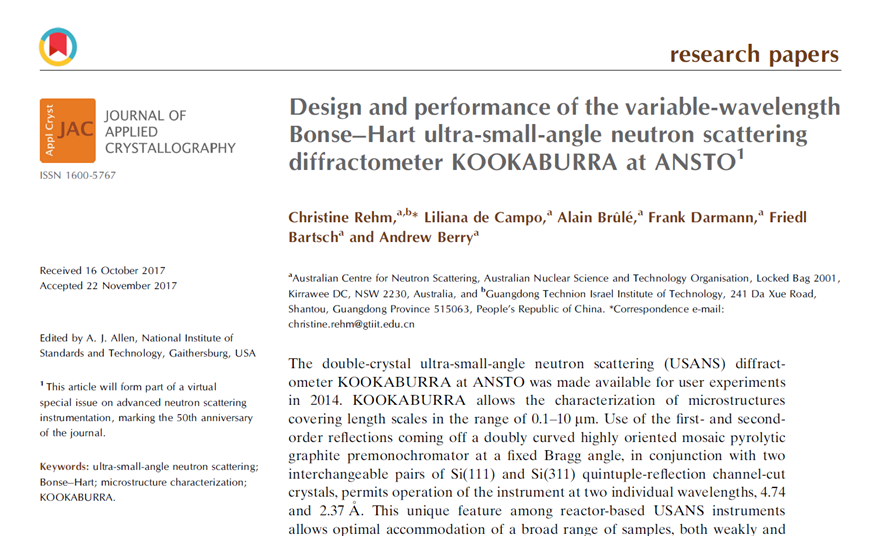
The first article describes the design and performance of one of the neutron scattering instruments available at the Australian Centre for Neutron Scattering (ACNS) at the Australian Nuclear Science and Technology Organisation (ANSTO). There, in my role as project manager I lead a team on the design, construction, licensing, commissioning and transition to operation of the ultra-small-angle neutron scattering (USANS) instrument named KOOKABURRA, suitable for the characterisation of microstructures. The first figure of the article shows the layout of KOOKABURRA with its main components indicated (picture in the following).The instrument became available for international research groups in 2014 and in my role as instrument scientist I then lead the operation of KOOKABURRA. Researchers doing experiments on this type of instrument can investigate a variety of sample materials on length scales ranging between 0.1 - 10 μm. Areas of interest include but are not limited to e.g. complex fluids like they are used in foods, cosmetics, or pharmaceuticals, and porosities of clays, cements or oil/gas-bearing rocks. Since both natural and synthetic materials science and engineering rely increasingly on detailed knowledge of the microstructure of and interactions in soft and hard materials, applying the USANS technique helps researchers to unlock the secret relationships between structure and function of materials to possibly improve their functionality.
?
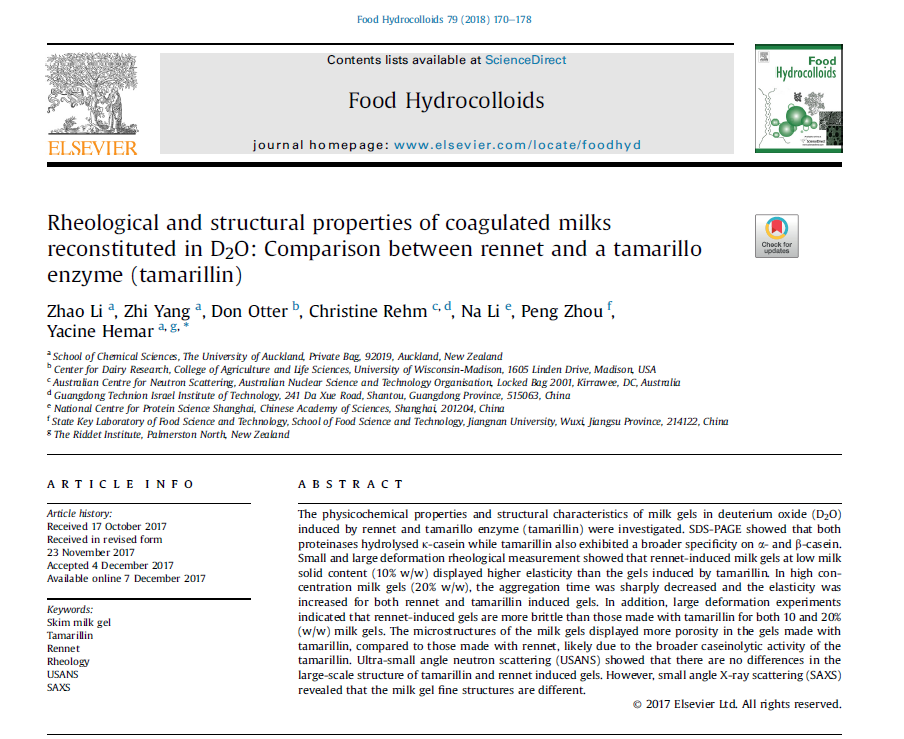
The second article discusses a typical research work in the area of food science, namely the study of cheese making through coagulation of the milk protein casein. A team of international researchers from New Zealand, USA, Australia and China performed USANS on KOOKABURRA and a variety of other experimental techniques to study milk gels. This work was motivated by the fact that hundreds of types of cheese that are produced worldwide use a milk clotting enzyme called rennet, which is obtained from the stomach of animals. A worldwide shortage of rennet plus the restriction of the use of animal rennet for religious and diet (vegetarianism) reasons, motivated the search for rennet substitutes as discussed in the article.
?
How long have you spent on the neutron scattering instrument, from design to the article published?
After having secured funding (A$3.2 million) for the construction of KOOKABURRA it took about 5 years until the instrument was readily installed and became available for research work, which is a typical time frame. In order to ensure that a state-of-the-art USANS instrument is built at the ACNS I travelled to other USANS facilities around the world and had many discussions with scientists about the best choice of all instrument components and their layout while complying to all safety requirements. Finally our team is proud to present the neutron scattering research community with a versatile, state-of-the-art tool for large-scale structure investigations. The first scientific research article of KOOKABURRA was already published in 2014, the same year the instrument became operational. Since then we have published more than a dozen of articles with KOOKABURRA data.
?
What are your academic plans in GTIIT?
I joined GTIIT in order to establish research infrastructure in physics and materials science. This means that I manage the setting up of a thin-film deposition laboratory for sample preparation as well as an X-ray laboratory for sample characterisation. For both, I have to identify the technical requirements and specifications for a variety of scientific equipment like a sputtering system and an atomic layer deposition system for sample preparation, and a versatile X-ray diffractometer for sample characterisation. The next step will be the procurement and commissioning of such devices. Once the two laboratories are up and running I will manage their operation. Besides providing the lab equipment to other GTIIT scientists I will also be able to establish my own research in the area of thin-film research. For doing neutron scattering experiments, however, we need to apply for beam time at other large user facilities like in Europe, USA, and Australia. In the near future, though, we would also like to use neutron scattering facilities in China like the China Spallation Neutron Source (CSNS), the China Mianyang Research Reactor (CMRR) and the China Advanced Research Reactor (CARR).
?
Text: GTIIT News & Public Affairs
Photos: GTIIT News & Public Affairs, Frank Klose
